Friday, August 30, 2013

Nintendo’s 2DS popping up for Pre-Order

Today when I glanced at Gamestop and Best Buy I saw the 2DS was available for pre-order. These retailers have decided to start taking orders just a few days after Nintendo’s the 2DS would hit shelves October 12th.
 
For those who don’t know the 2DS is a DS console that can play 3DS games and regular DS, but the catch is it can only do 3DS games in 2D. The new handheld also doesn’t sport Nintendo’s clamshell design, so it isn’t pocket friendly, unfortunately.

The new DS also has support for Nintendo’s eShop where gamers can purchase and download both new and retro games from SNES, NES, GBC, and Gamegear.


Currently the console can be pre-ordered for $129.99 in Crimson Red or Electric Blue and comes with a 4GB SD card, the console itself of course and a wall charger.

Wednesday, August 28, 2013

Nintendo Announces New 2DS Handheld Console


Nintendo currently has a stranglehold on the handheld console market for years and its 3DS currently reigns supreme over Sony's PS Vita. The newest edition to the DS family is the firm's budget-minded $130 2DS, which was announced earlier today. The device is slated to have a October 12th release date once its passed FCC quality controls.

The cheaper DS will be able able to play 3DS games and is backwards compatible with regular Nintendo DS games too. The only caveat is that you won't be able to the games with Nintendo's 3D features, thus the name 2DS.


You'll also be able to access the Nintendo's eShop to buy downloadable games. The store features classic retro games which include my favorites Zelda Oracle of Ages/Seasons, Majora's Mask, and Super Metroid. These blast to the past games are super duper cheap at just $5 a piece making the eShop a great feature for the 2DS to have.

Nintendo's squeezed a SD card slot into the 2DS just like they did with their 3DS and you'll be able to store downloadable games, apps, and saves onto the card.

Nvidia's Shield handheld was released a few weeks for an MSRP of $300 and now faces stiffer competition from Nintendo to lower its price. The Shield is still far more expensive than Nintendo's current DS offerings as the 3DS and 3DS XL sport MSRPs of $200 and $170, respectively.

Thursday, August 22, 2013

EVGA Video Cards now to come with Double Bios

If your overclocking fails try again

Obliterating a video card’s Bios by overclocking it to much way can make into a glorified paper weight. To solve this problem, EVGA has now started making its video cards with its new “Double Bios”. The feature gives users two Bios to mess around with, so if their video card’s Bios gets corrupted they can flick a switch and it can be set back to its default bios.


The company says that its “Double Bios” feature is to help unlock the additional power of overclocking and to allow users to experiment with its new cards. EVGA will offer this feature on its 700-series video cards which range from the GTX 760 up to the GTX 780.


EVGA is celebrating the new release of its new “Double Bios” video cards by giving away 2 GeForce GTX 780, 770 and 760s. You enter to win these cards here.

Tuesday, August 20, 2013

ASUS Launches H81 Series Motherboards

A set of Entry-Level Haswell boards


Asus has announced that it will be releasing six entry-level motherboards sporting Intel’s entry-level H81 Haswell chipset. The boards feature several different form factors which include ATX, Micro-ATX, and Mini-ATX.

The H81 series is comprised of the H81-Plus, H81M-Plus, H81M-A, H81M-C, and the H81M-E and the H81I-Plus. All of boards include two DDR3 1600Mhz dimm slots supporting up to 16GB of RAM and one PCI-Express x16 slot (@16). Other specifications include two SATA 6GB/s ports, Realtek 7.1 Audio, and USB 3.0.

Asus claims its new boards feature 5K gold capacitors which are supposed to “last more than twice as long as traditional electrolytic capacitors — over 50 years of continuous use under typical conditions (at 65 degrees Centigrade).”

Currently there is no word on how much the new H81 boards will cost. However, on Newegg H87 motherboards are priced at $80-$120, so the H81 motherboards should be around the same price or cheaper.

Friday, July 26, 2013

Google Refreshes its Nexus 7 Tablet

The original Nexus 7 launched last year in mid July for $200 and Google has finally released its successor. This refreshed tablet is Google's 2nd generation of the device and it is slightly more expensive than the original Nexus 7. The entry level 16GB model is currently retailing for $220 and a 32GB version is selling for $270. Google's newest Nexus device comes with a slew upgrades over its original 7 inch slate.

Google decided to up the retinal display on its newest device as the new Nexus 7 sports a 1920x1200 screen whereas the original had a 1280x800. We're excited about this as it means the Nexus is going from 216 pixels per inch (PPI) to 323 PPI.

Another welcomed upgrade coming to the Nexus 7 is its updated processor and RAM. Last year's device rocked a Tegra 3 ARM CPU clocked a 1.2GHz, which is replaced by the more powerful 1.5GHz Snapdragon S4 Pro. The first gen Nexus featured 1GB of RAM while the newest model is rocking 2GB giving users more power for multitasking goodness.

Google didn't change the Nexus 7's 1.2MP front facing camera, but it added a 5MP rear facing camera and slightly reduced the tablet's weight too. Last year's model weighed in at 0.74 lbs while the 2013 slate weighs 0.64 lbs. The weight reduction is probably because the Nexus 7 now has a smaller 3950 mAh battery instead of the 4325 mAh variety found in the first gen model.

If you want to get your hands on the slate you can purchase one from Best Buy as the retailer just started selling them. Another place to purchase the tablet is the Google Play store, though it won't sell through that outlet until July 31st.

We're excited about the new Nexus tablet and hope this refresh means Google will release an updated version of its Nexus 4 phone soon too.

Sunday, June 16, 2013

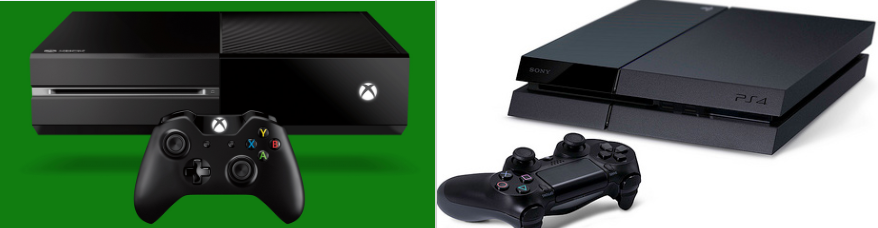
Why Videogames won't Look Much Better on PC because of Xbox One and PS4


Sony's and Microsoft's new consoles are about to launch this November just before the 2013 Holiday season. What does this mean for gamers? Well if you're a console gamer you'll get your much anticipated Next-Gen console at this time and it will be great. If you're on the PC on the other hand you won't see much of a difference and I'll tell you why.

-Chris Zele

Reason 1: The Next Gen Consoles have Low-End Hardware

The Xbox One and PS4 both run an AMD APU aka Advanced Processing Unit which combines the processor and graphics card onto a single chip. The problem with the APUs being used in the Next-Gen Consoles is that they are using AMD's Jaguar cores which aren't very high end as they are equivalent to Intel's Atom processors. Yeah does Atom ring a bell the processor that powered all of those shitty notebooks from yesteryear and yes it's that bad.

Reason 2: Games Cost a lot of Money to Make

Big budget games from developers like Square Enix, Ubisoft, and Rockstar need to sell millions of copies to break even as development costs can be 60+ million dollars. The result of extremely high development costs has made it so developers/publishers have been closing down left and right. THQ is the biggest company to close down in recent memory and it looks like Square Enix may be the next company to implode as its recent titles haven't sold very well. 

What does the last paragraph have to do with PC gaming? Our take is that PC gaming is not going to get better because developers are going to cut back on dev costs because they have been going into debt recently. Devs will most likely scale back costs and make lower fidelity games or games that look marginally better than they do now for PC users. Case in point, have you taken a look at the newest Battlefield 4 trailer? It looks the same as Battlefield 3, so visually it hasn't gone anywhere from the last game and this is likely the case for other upcoming games.

Reason 3: The New Consoles aren't Upgradeable

When PC gamer's want to upgrade their rigs they do so whenever they please. If you're an Xbox 360 or PS3 gamer your hardware is locked down and you can't add more RAM or upgrade the video card or CPU. The Next-Gen consoles will hold back PC gaming just as the previous consoles have done before. I just don't see the new consoles pushing gaming into the next generation with their lack of upgradeability. PCs can see a large boost in performance when their video cards are replaced but the consoles will see no such boost and will be left in the dust in no time. 

Video Card: Buyers Guide AMD VS. Nvidia


When it comes to GPUs there are a plethora of options to choose from scaling from $50 all the way up $1000. In this buyers guide we'll tackle all the price points to tell you where to spend your money from entry level cards all the way up to the ultra high-end enthusiast performance video cards.

Entry Level: $150 AMD Radeon 7790 VS Nvidia 650 Ti

Most people consider an entry level video card a $50-$100. Recently CPU graphics from both Intel and AMD have caught up to discrete video card performance and made it, so people don't need to buy a low end GPU anymore.

Anyways lets compare AMD's 7790 to the Nvidia's 650 Ti which are both around $140-$150 or so. When you look at the benchmarks the 7790 beats the 650 Ti in almost every benchmark that Ryan Smith from Anandtech ran on the two GPU's. The AMD GPU also came very close to the performance of the 650 Ti Boost which is currently a $170 video card. AMD's 7790 card won all of the compute tests beating out both Nvidia cards handily in synthetic benchmarks. What makes AMD's 7790 appealing is its $110 game bundle consisting of Bioshock Infinite, Tomb Raider, and Far Cry 3 Blood Dragon.

Winner: AMD

Mid Range: $250-$300 AMD Radeon 7950 
VS Nvidia GTX 760


There are many options at this price point ranging from Super-clocked GTX 660's to stock clocked Radeon 7950's. The two card facing off here are the AMD 7950 at $260 VS Nvidia's GTX 760 at $250. The GTX 760 wins almost all of the gaming benchmarks run by Anandtech and when it does lose to the 7950 its not by much. Games where the GTX 760 killed AMD's second tier card were BF3, Portal 2, and Skyrim which the Nvidia card won beat the 7950 by around 10FPS or more in each of these games.

Winner: Nvidia

High End: 7970 GHz Edition VS GTX 770 $350-$400


The battle at the high end is insane as AMD and Nvidia as both companies are very close to each other in this price bracket. AMD offers their 7970 GHZ Edition here while Nvidia has their newly launched GTX 770 here. Both video cards are very close to one another when it comes to performance and power consumption. If you're at this price point and want the card that is the faster of the two right out of the box choose the 7970. However, if you're an overclocker you'll want to go with the GTX 770 as the video card overclocks well and pushes past AMD's flagship card handily after it's overclocked to 1200MHz.

Winner: Tie

Ultra: $1000 7990, VS GTX 690, VS GTX Titan 


When it comes to the Ultra category three cards stand out at the premium price of $1000 which include Nvidia's GTX 690 and GTX Titan along with AMD's Radeon 7990. Nvidia's GTX Titan beats the GTX 690, and 7990 single handily in this category. The Titan is a single GPU card where as the 690 and 7990 are both dual-GPU video cards and it performs the same if not better them in some cases. In Anandtech's review of the card the GTX Titan matched the 690 and 7990 in many of the website's benchmarks. However, the Titan did lose to both the 690 and 7990 many times in benchmarks, but the card's advantage is that you don't need to wait for Crossfire or SLI profiles to come out like you do for the 7990 or GTX 690.

Winner: Nvidia's GTX Titan